Small Stake, Big Impact: The Math Behind the 1% Crypto Rule
"From skeptic to investor: Learn the math behind the '1% Crypto Rule.' A simple, low-risk strategy to cap your downside while capturing massive upside"
For the longest time, I stayed away because, to me, Bitcoin didn’t have any intrinsic value. It wasn’t something I could touch, hold, or feel, like a bar of gold or a silver coin.
If the power went out, what did I actually own? It felt like magic internet money with no foundation.
But then, I started digging deeper. I wasn’t just learning about crypto, I was learning about the financial system itself.
I studied banking industry how it works, how the economy actually functions, and the reason of why the US Dollar is the global reserve currency.
Once I understood how traditional money works and how much of it is printed the concept of a digital, limited-supply currency started to make sense. That was my “aha” moment.
Now, I’m not saying I went all in. I didn’t sell my house to buy Bitcoin. Instead, I adopted a strategy that changed everything for me: the 1% Portfolio.
(Disclaimer: I am sharing my personal story and research. This is not financial advice. Investing involves risk, so always do your own research.)
What is the 1% Rule?
The 1% rule is exactly what it sounds like. It is the practice of allocating just one percent of your total investment portfolio to cryptocurrency (like Bitcoin), while keeping the other 99% in traditional, safer assets like stocks, bonds, real estate, or cash.
It sounds almost too small to matter, right? If you have $10,000 to invest, that means putting just $100 into crypto.
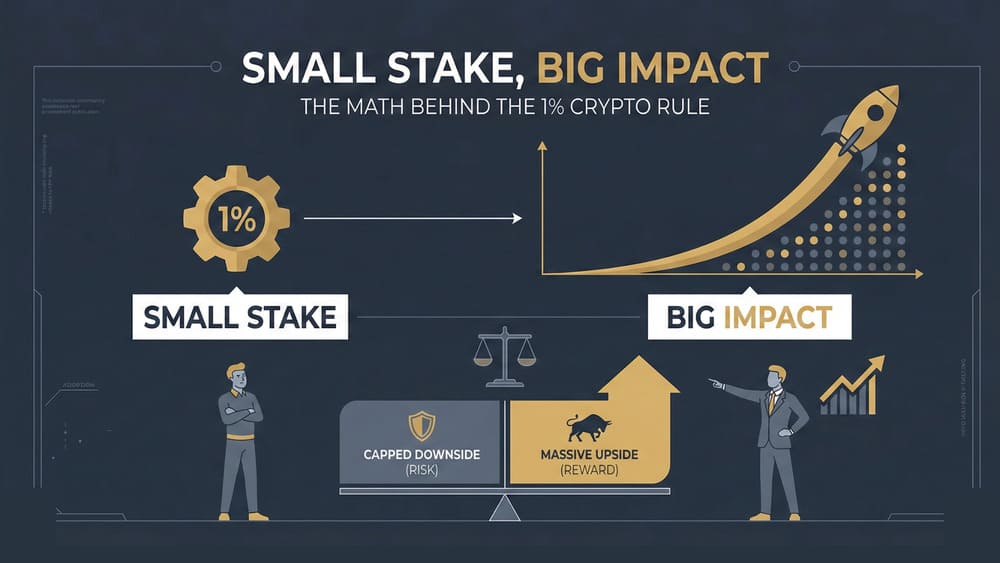
But that’s the beauty of it. It is an “asymmetric bet.” In plain English, that means the potential upside is massive, but the downside is strictly limited. It allows you to participate in the growth of a new technology without losing sleep at night.
Why It’s the Ideal Strategy

Think of the 1% rule like buying an insurance policy, but in reverse.
When you buy car insurance, you pay a small premium to protect yourself against a disaster. You hope you never use it, but you pay it just in case.
With crypto, that 1% is your premium. But instead of protecting against a car crash, you are buying a ticket to a potential financial revolution.
- If crypto goes to zero: You lose 1% of your portfolio. It stings, but it won’t ruin your retirement. You still have 99% of your wealth intact.
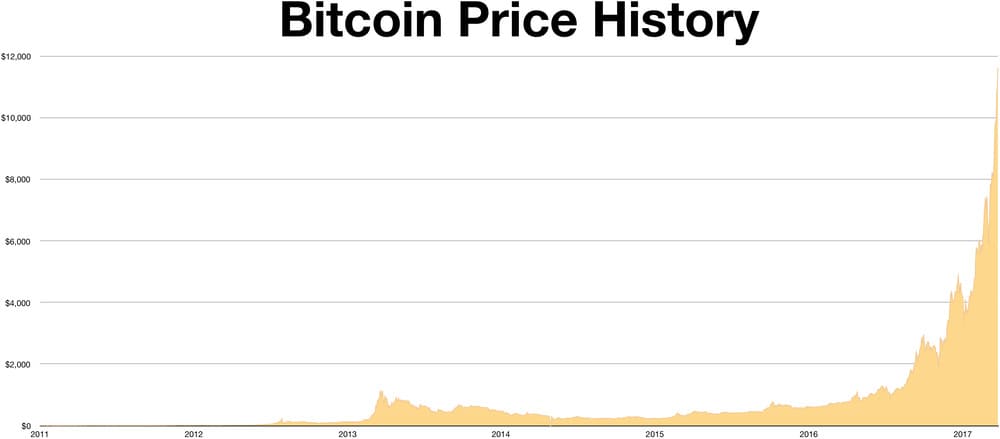
- If crypto succeeds: If it doubles, triples, or goes 10x over the next decade (as it has in the past), that tiny 1% can grow large enough to significantly boost your overall returns.
It solves the biggest emotional problem in investing: FOMO (Fear Of Missing Out). By holding just 1%, you never have to feel bad when you see Bitcoin on the news hitting a new all-time high, because you have “skin in the game.”
Who Is Actually Doing This?
I used to think only tech geeks or gamblers bought crypto. But when I did my research, I realized some of the smartest, most conservative investors in the world are using this exact strategy.
Take Paul Tudor Jones, for example. He is a billionaire hedge fund manager, a legend in the finance world. In 2020, he famously announced he put about 1% to 2% of his assets into Bitcoin. He viewed it as a hedge against inflation essentially, protection against the dollar losing value.
Then there is Ric Edelman, one of the most respected financial advisors in the US. He explicitly tells people: “You don’t need to put in a lot.” He argues that a 1% allocation is the perfect balance because it minimizes risk while capturing the upside.
Even massive insurance companies like MassMutual have dipped their toes in, buying around $100 million in Bitcoin. That sounds like a lot of money, but for them, it was less than 0.1% of their total investment account.
If the big guys are treating it as a small, strategic piece of the puzzle, maybe we should too.
The Math Behind the 1% (Simple Example)
Let’s look at the numbers to see why this works. I’ll keep the math very simple.
Imagine you have a total savings of $10,000.
- You keep $9,900 (99%) in a safe, standard index fund (like the S&P 500) or a savings account.
- You put $100 (1%) into Bitcoin.
Bad Scenario: Crypto Crashes Let’s say the skeptics are right. Bitcoin gets banned, the network fails, and the value drops to $0.
- You lose your $100.
- You are left with $9,900.
- Result: Your life doesn’t change. You can still pay your rent. You can still retire. It’s a bad weekend, not a bad life.
Good Scenario: Crypto Bullish Let’s say we enter a “bull market” and Bitcoin goes up 10x (which has happened multiple times in its history).
- Your $100 becomes $1,000.
- Your $9,900 (assuming it grew a modest 8% in the stock market) becomes $10,692.
- Total: You now have $11,692.
The Impact: That tiny $100 investment just added nearly 10% to your total net worth.
This is the power of the 1% rule. The math shows us that the risk is capped at -1%, but the reward is theoretically uncapped. In the investing world, that is the “Holy Grail.”
Conclusion
For me, the 1% rule was the bridge between skepticism and action. It allowed me to stop worrying about whether Bitcoin was “real” enough to touch, and start treating it as a financial tool.
If you are sitting on the sidelines, nervous about the volatility but curious about the technology, you don’t need to dive into the deep end. You don’t need to be a day trader. You just need to be smart about your sizing.
By risking a little, you open the door to a lot. And if I’m wrong? Well, I’m only wrong by 1%. I can live with that.
Common Questions
Q: Do I need to buy a whole Bitcoin to start? A: No! This is a common myth. Bitcoin is divisible, like a dollar is divisible into cents. You can buy $10 worth or $50 worth. You can own 0.0001 BTC.
Q: What if that 1% grows to become 10% of my portfolio? A: That’s a good problem to have! This is called “rebalancing.” If your crypto grows too big and you feel it’s too risky, you can sell some of the profits and put it back into your safer investments to bring it back down to your comfort zone.
Q: Is 1% the limit? Can I do 5%? A: The 1% rule is a starting point. Some investors, like Paul Tudor Jones, eventually moved to 5%. However, once you go above 5%, the volatility of crypto will start to drastically affect your total portfolio swings. For beginners, 1% is the “sleep well at night” number.