The Silent Thief: Why Your Savings Account is Actually Losing You Money
"We are taught that 'cash is king,' but inflation is silently eroding your wealth. Learn the math behind real returns and how to protect your purchasing power."
Growing up, my parents drilled one rule into my head: “Save your money in the bank.” To them, the bank was a fortress. It was the only place where money was truly safe from the chaos of the world.
For years, I followed that advice religiously. I watched my savings account balance grow, feeling a sense of security every time the number went up. I thought I was winning the financial game simply by not spending.
But then, I had a realization while buying groceries. I looked at the price of eggs and milk compared to five years ago. The price tag had jumped nearly 30%, yet the money sitting in my “safe” bank account had barely grown at all.
That was the moment I realized the uncomfortable truth. I wasn’t saving money; I was slowly losing it.
(Disclaimer: I am sharing my personal story and research. This is not financial advice. Market conditions change, so always do your own due diligence.)
The Invisible Tax We All Pay
We often think of risk as seeing our account balance go down. If you have $10,000 and the market crashes to $8,000, that feels like a loss. We can see it, and it hurts.
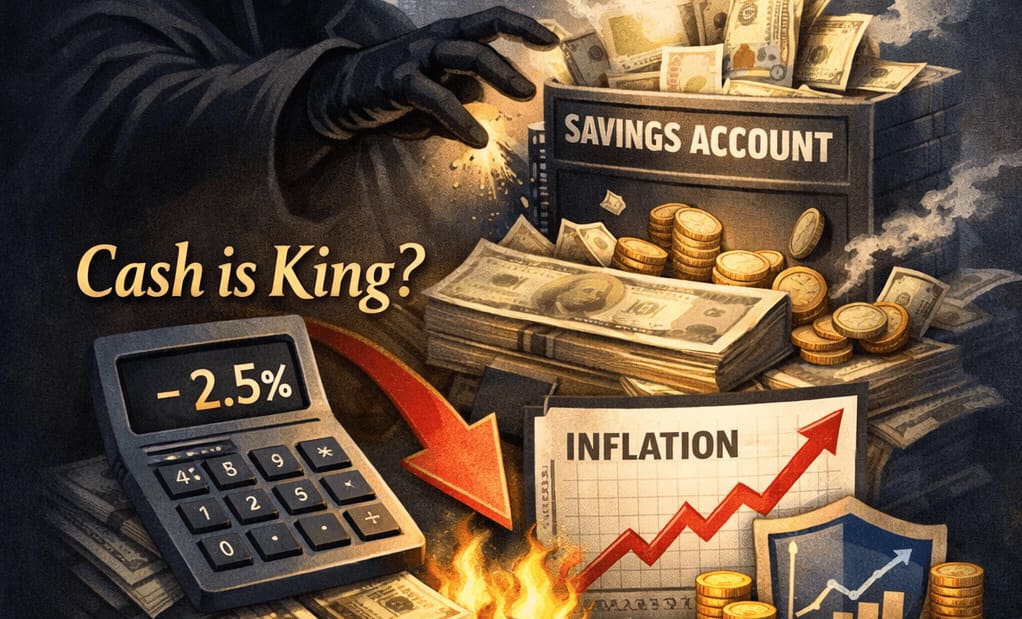
But there is a more dangerous type of loss that is invisible. It is called Inflation. This is the rate at which the price of goods and services rises over time.
Think of inflation like a slow leak in a tire. You might not notice it day-to-day, but over a year, the air pressure drops significantly. Your car (your money) simply cannot go as far as it used to.
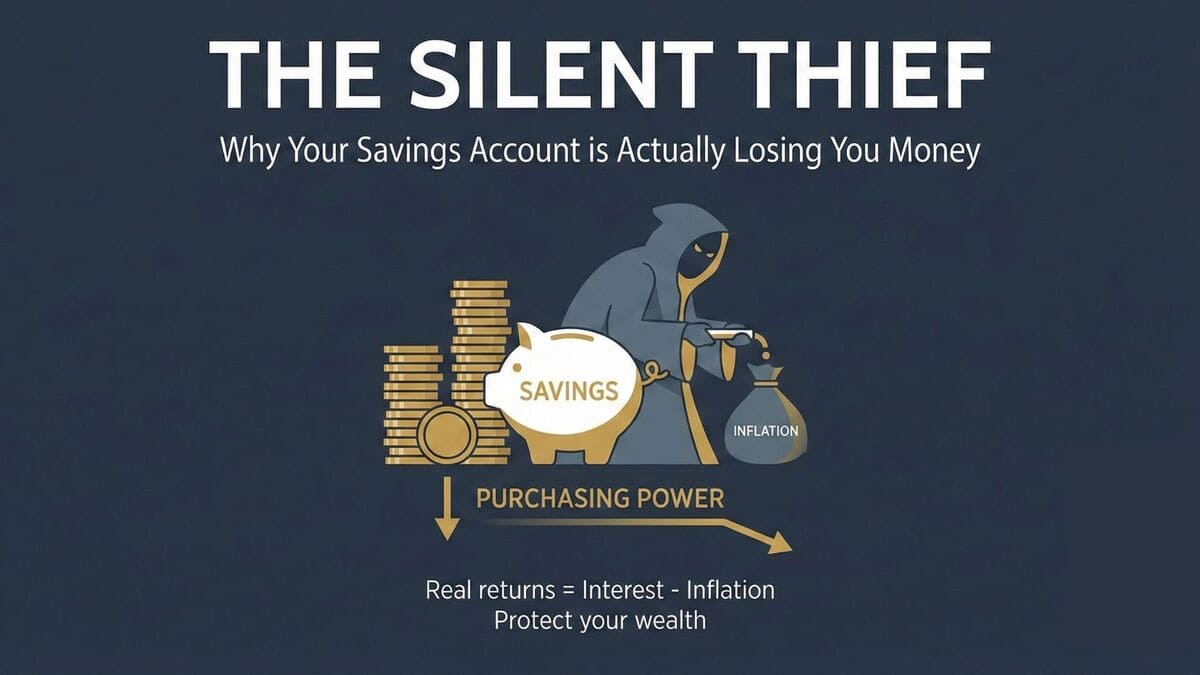
If inflation is running at 3% per year, your money is losing 3% of its buying power. If your bank is only paying you 0.5% interest, you are guaranteed to lose value every single day.
The Math: Real vs. Nominal Returns
To understand this, we need to look at two different numbers. The first is the Nominal Return. This is the interest rate the bank advertises to you (e.g., “Earn 4% APY!”).
The second number is the Real Return. This is the number that actually matters. The formula is simple:
Real Return = Interest Rate Inflation Rate
Let’s look at a scenario from recent history. Imagine your high-yield savings account pays you 4%. You feel great about this. However, inflation that year is running at 5%.
Your Real Return is -1%.
Even though your account balance is higher at the end of the year, you can actually buy fewer things with that money than you could when you started. You have essentially paid the bank to hold your cash.
The Coffee Shop Test
I like to use the “Coffee Shop Test” to visualize this. Ten years ago, a crisp $20 bill could buy me coffee and lunch for two people. It felt like a substantial amount of money.
Today, that same $20 bill might barely cover a sandwich and a latte for just myself. The paper bill hasn’t changed. It is still green, and it still says “20.” But its value has evaporated.
This is why hoarding cash is dangerous long-term. Cash is designed to be spent, not stored. Central banks intentionally target a small amount of inflation to keep the economy moving.
If you leave your life savings in cash for 20 or 30 years, you aren’t playing it safe. You are guaranteeing that your hard-earned wealth will be cut in half.
So, Where Should the Money Go?
Does this mean you should drain your bank account? Absolutely not. You still need a Emergency Fund. This is 3 to 6 months of expenses kept in cash for unexpected events like job loss or medical bills.
But for any money beyond that safety net, you need to move it into assets. You need to own things that have the potential to grow faster than inflation.
- Stocks/Equities: Owning shares of companies that can raise their prices as inflation rises.
- Real Estate: Property values and rents tend to track with inflation over time.
- Commodities: Things like Gold or even Bitcoin (for a small allocation) often act as a hedge against currency debasement.
The goal isn’t to get rich overnight. The goal is to simply run faster than the “Silent Thief” so your purchasing power stays intact.
Conclusion
My parents weren’t wrong; they just lived in a different era. In their time, savings accounts often paid much higher interest rates that actually beat inflation. But in our current economic environment, the rules have changed.
Don’t let the illusion of a stable account balance fool you. If your money isn’t growing, it is dying. It is the cost of doing nothing.
Start by checking your bank’s interest rate and comparing it to the current inflation rate. Once you see the gap, you will realize that investing isn’t riskyit’s necessary.
Common Questions
Q: Should I never keep money in a savings account? A: No, you absolutely need cash for emergencies and short-term goals (like a vacation or wedding in the next 1-2 years). The goal is to not hold excess wealth in cash for the long term (5+ years).
Q: What is a “High-Yield” Savings Account (HYSA)? A: This is a savings account that pays a higher interest rate than a traditional big bank. While a normal bank might pay 0.01%, an HYSA might pay 4% or 5%. It is much better, but still might not beat high inflation.
Q: How do I find out the current inflation rate? A: You can search for the “CPI” (Consumer Price Index) for your country. This is the government’s official measure of inflation. If the CPI is 3%, you need your investments to earn more than 3% to break even.
Q: Is investing in the stock market safer than a savings account? A: In the short term? No, the stock market is volatile and can drop. But in the long term (10+ years), holding stocks has historically been much “safer” for preserving purchasing power than holding cash.
References
- U.S. Bureau of Labor Statistics. (2026). Consumer Price Index Summary: January 2026.
- Housel, M. (2020). The Psychology of Money. Harriman House.
- Vanguard. (2025). Vanguard Economic and Market Outlook 2026: Fighting the Inflation Narrative.
- Investopedia. (2026). Real Rate of Return vs. Nominal Rate of Return.
- Bridgewater Associates. (2025). Principles for Navigating Big Debt Crises and Inflation.